
[ad_1]
By Gina Lee
Investing.com – Asia Pacific stocks were up on Friday morning, while U.S. equity futures wavered. However, investors continue to calculate the economic and monetary-policy impact of Thursday’s Russian invasion of Ukraine and the Western sanctions on Russia that followed.
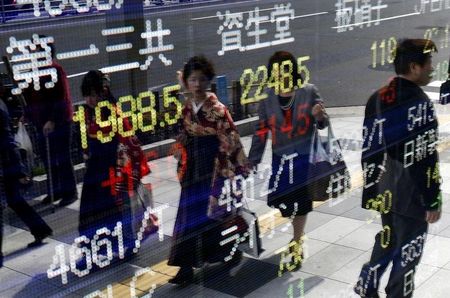
Japan’s climbed 1.56% by 9:08 PM ET (2:08 AM GMT). Data released earlier in the day showed that the grew 0.5% year-on-year in February 2022. The grew 1% year-on-year, while the index grew 0.2% month-on-month.
South Korea’s rose 1.04% and in Australia, the was up 0.38%.
Hong Kong’s was up 0.35%.
China’s rose 1.28% and the rose 1.18%.
U.S. shares fell after Thursday’s volatile session that saw the gain 1.5% and the briefly fall into a bear market before climbing 3.4%. U.S. Treasuries were mixed, with the benchmark 10-year yield moving upward. In Asia Pacific, bonds in Australia and New Zealand fell.
U.S. President Joe Biden swiftly slapped stiffer penalties on Russia after the latter’s forces moved towards the Ukrainian capital city of Kyiv. The measures include sanctions against five major Russian banks to block their access to foreign currency.
With Russia and Ukraine both major grain exporters, investors are weighing the potential impact of the invasion. These include possible inflation and the impact of Western sanctions. With almost $200 billion in stock-market value, and roughly a third of the sovereign debt’s value wiped out in Russia, the Central Bank of the Russian Federation (Bank of Russia) took emergency action.
Biden’s announcement leaves markets “looking at some additional sanctions being added but certainly not as bad as it possibly could have been,” State Street Corp (NYSE:). macro strategist Emily Weis told Bloomberg. That contributed to the Wall Street “risk rally,” she added.
Meanwhile, the U.S. Federal Reserve is likely to hike interest rates in March 2022 despite the uncertain situation in Ukraine. Cleveland Fed President Loretta Mester said that “barring an unexpected turn in the economy, I believe it will be appropriate to move the funds rate up in March and follow with further increases in the coming months.”
Although expectations of central bank interest rate hikes have slightly decreased, the Fed is widely expected to implement around six hikes. Across the Atlantic, the European Central Bank said the repercussions of the Russian invasion of Ukraine could delay, but not stop, asset tapering in 2022.
“How is the Fed going to react to this geopolitical risk?” Optimal Capital Advisors director of strategy Frances Stacy told Bloomberg. “That’s where we’re seeing spikes, where we start to try and reprice speculation around that.”
U.S. data, including , the , and the , is due later in the day.
[ad_2]
Source link
