
[ad_1]
Speaker of Parliament Mahinda Yapa Abeywardena confirmed the appointment during a televised address Wednesday.
Rajapaksa — who had been expected to resign Wednesday but fled before doing so officially — made the appointment, citing a section of the constitution that allows a prime minister to “discharge the powers, duties and functions of the office of President” when the President is ill or “absent” from Sri Lanka.
Wickremesinghe had been expected to formally resign as prime minister on Wednesday “to make way for an all-party government.”
The move came as Wickremesinghe’s office said he planned to call a state of emergency across the country, as protesters took to the streets of the commercial capital Colombo amid an economic crisis marked by dire shortages of food, medicine and fuel.
He also directed the Ministry of Defense to impose a curfew across Colombo and the rest of the country’s Western province after police fired tear gas on crowds outside the prime minister’s office, a ministry official told CNN.
The official, who did not wish to be identified, said Wickremesinghe ordered that “unruly persons and those traveling in lorries be arrested.”
Rajapaksa and his wife flew to Malé, in the Maldives, on an AN32 troop transport plane from the Sri Lanka Air Force, according to a high-ranking security official, shortly before he was due to step down.
Maldivian air traffic control refused the plane’s request to land until an intervention by the Speaker of the Maldivian Parliament and former President Mohamed Nasheed, according to the official. A spokesperson for Nasheed did not confirm or deny the intervention.
Sri Lanka’s Air Force on Wednesday confirmed Rajapaksa’s departure, saying in a statement: “Pursuant to the request of the government and in accordance with the powers vested in a President in the Constitution of Sri Lanka, the Sri Lanka air force provided a plane early today to fly the President, his wife and two security officials to the Maldives.”
Following his departure, hundreds of protesters gathered outside the prime minister’s office in Colombo, chanting and demanding that neither the President nor the prime minister “be spared.”
Live video seen by CNN showed protesters marching toward the prime minister’s office building, shouting that the leaders are trying to flee.
Police used tear gas to disperse a group of protestors trying to break through barriers outside the building.
Aides for Rajapaksa arrived at the airport in Colombo on Monday with 15 passports belonging to the President and members of his family — including First Lady Ioma Rajapaksa — who had booked seats on a Sri Lankan Airlines flight leaving for Dubai at 6:25 p.m. local time, according to the military source.
But immigration officers declined to process the passports given to them by presidential aides, as Rajapaksa and his family were not physically present for cross checks. Eventually, the flight departed without the President and his family on board, the source added.
Another attempt was made to get the family on an Etihad flight scheduled to leave Colombo for Abu Dhabi at 9:20 p.m. local, according to the source, however the same problem occurred, as the Rajapaksas refused to join the public immigration queue for the flight.
In both instances, the Rajapaksa family was in a nearby airport lounge, waiting for confirmation they could board without queuing among members of the public, the source said.
On Tuesday, a video released by a former police officer claimed that Rajapaksa was staying in a private house belonging to a top air force commander. The Sri Lanka Air Force has denied the claim, describing it as propaganda intended to tarnish the image of the corps and its chief.
Forced to resign
Rajapaksa’s planned resignation on Wednesday — which follows months of protests over the country’s crippling economic crisis — would leave him without presidential immunity and potentially exposed to a raft of legal charges in the country.
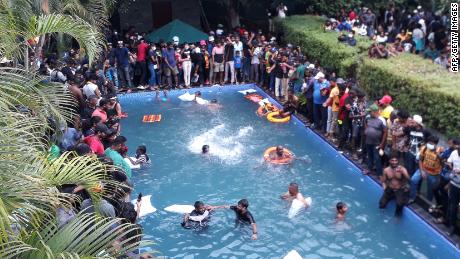
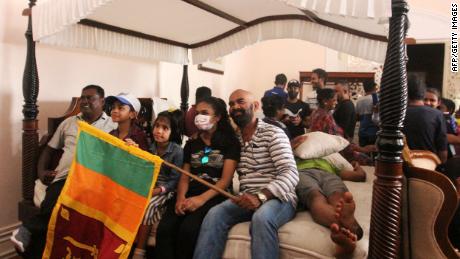
Striking images shared on social media showed demonstrators singing protest songs and chanting slogans calling for Rajapaksa to resign. Other photos showed groups of demonstrators setting up barbecue pits to grill food.
Reporting contributed by journalist Rukshana Rizwie.
[ad_2]
Source link
