
[ad_1]
A few days ago we wrote about how the NASA is interested in new technologies regarding critical components such as heat shields. Specifically it is developing one inflatable heat shield called LOFTID (which means Low-Earth Orbit Flight Test of an Inflatable Decelerator) which could bring several advantages to future interplanetary missions but also to those that take place in low earth orbit (with or without crew).
We are still far from a model that can actually be used in operational missions, but the agency is still carrying out the experimentation not only in the laboratory but also “on the field”. What better opportunity than the launch of a satellite to take advantage of “a passage to Space” and thus to be able to re-enter towards the surface to understand if the idea can actually be developed. So here is that LOFTID was aboard a Atlas V rocket (model 401) together with the Joint Polar Satellite System (JPSS) -2.
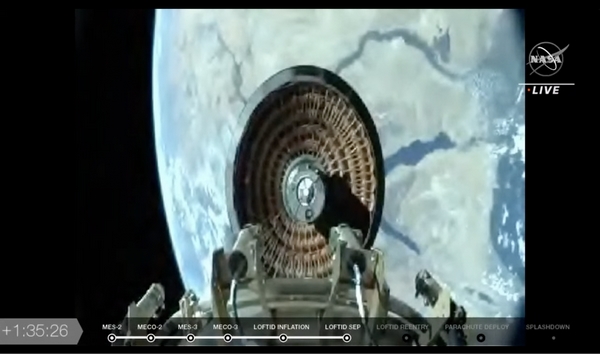
NASA tests an inflatable heat shield called LOFTID
When it was 10:49 today (Italian time) the Atlas V rocket realized by ULA took off from Vandenberg Space Force Base (Space Launch Complex 3) to bring the two payloads into orbit. Priority was given to NOAA’s JPSS-2 satellite, but much attention was paid to LOFTID once the first has separated properly from the second stage (Centaur).
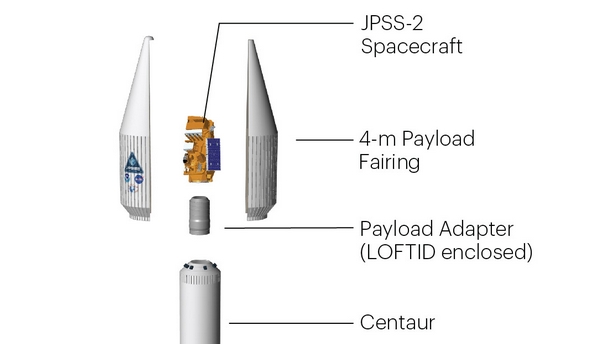
In particular it inflatable heat shield it was folded inside a container fixed on the top of the second stage and under the satellite (so that the latter could be released first). One of the peculiarities of this idea is precisely that of reducing the overall size when not in use by folding in on itself. With this strategy it was therefore possible to enter LOFTIDwhich has a diameter of 6 meters when open, inside fairing decidedly smaller having a maximum diameter of 4 meters.
JPSS-2 was successfully released after 28 minutes of take-off in a sun-synchronous orbit at an altitude of 800 km. The inflatable heat shield, still closed, it was released from Centaur about 75 minutes after launch. This time was used for two starts of the upper stage engine to enable LOFTID to have the right trajectory. Furthermore, to improve stability during the descent towards the surface at LOFTID, a rotation of 3 rpm has been applied.
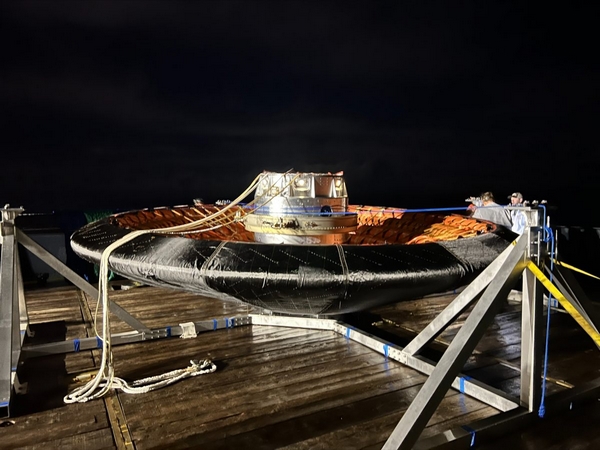
The inflatable heat shield it landed in the Pacific Ocean near Hawaii after 2 hours and 13 minutes of take-off (stopped in its descent by a parachute). A boat has recovered LOFTID from the waters so as to be able to conduct the necessary analyzes. Being a test there was not a real payload, but a series of sensors to record different types of data. In the future, human missions and thus will not be able to count on lighter and less bulky heat shields (when not inflated) allowing better management of the payload, better rocket efficiency and safeguarding the lives of astronauts (especially thinking of missions such as those to Mars).
 A A480GB SATA SSD to less than 40? Today yes, come on Amazon! Resurrect old PCs, add high-speed GB to desktop, in short, the occasion not to be missed! |
Gift ideas, why waste time and risk making mistakes?
GIVE A GOOD AMAZON!
.
[ad_2]
Source link
