
[ad_1]
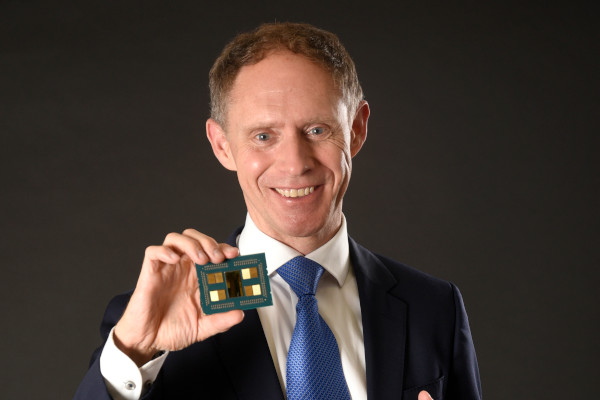
We receive and publish this article on the importance of updating server hardware. The piece signed by Roger Benson (pictured below), Senior Director, Commercial EMEA at AMDand stresses that having recent hardware is essential to reduce operational expenses and better address the challenges that companies have to manage.
A push for innovation: why hardware upgrades can make a difference
In a market that is becoming increasingly competitive, companies must invest in technology from a strategic perspective in order not to compromise efficiency, safety and competitiveness in the long term.
Many enterprises, intimidated by upfront costs, forgo investing in new hardware such as servers, but relying on hardware that is not up to date or kept efficient often involves even greater management costs and capital expenditures. In other words, the day-to-day expenses of out-of-date hardware can quickly outweigh the costs of short downtime or initial investments for a new system.
This is not the only possible consequence of a failure to update the hardware. Companies opting to move to new systems will have greater access to technologies such as artificial intelligence (AI) and Big Data Analytics (BDA), which offer faster decision making, the availability of new information and an increase in productivity like never before. As a result, companies that continue to use outdated systems risk accumulating an innovation disadvantage compared to their competitors, as well as losing customers who require modern and customized solutions.
This topic of crucial importance for companies of any sector and size. Before AMD introduced its EPYC line of server processors in 2017, the x86 server industry was static and unrivaled, so innovation was slow and limited to modest performance improvements from generation to generation. However, with the arrival of new hardware solutions in recent years, companies are able to innovate, achieve results faster, and even potentially reduce the installed server base, minimizing upfront capital investments and ongoing operating costs.
Costs
It should be noted that while costs are among the most significant impediments for companies planning to upgrade hardware, a company will also need to take into account the costs of downtime.
A digital transformation project can appear expensive, particularly when it involves a major upgrade such as moving to new on-premise hardware or transitioning from legacy infrastructure to pay-per-use models such as SaaS. However, once the company has taken this path, management costs are very likely to decrease. For example, upgrading to high-core AMD EPYC processor-based systems can not only reduce maintenance frequency and simplify IT management, but also allows enterprises to host multiple users and workloads on a single servers, as well as reducing the total number of servers required, while reducing the need for electricity to power and cool new systems.
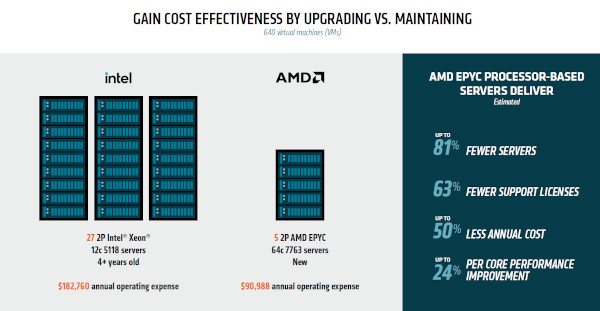
Additionally, the upgrade to AMD EPYC, which is widely used on AWS, Microsoft Azure, and Google Cloud platforms, enables enterprises to leverage the benefits of service models such as SaaS, IaaS, and hybrid cloud, while reducing capital expenditures. In this way, companies can reduce annual costs by up to 52%, use 63% fewer VMware vSphere licenses and achieve 10% more performance / core through refresh, with 81% 1 fewer servers .
Performance
Businesses that continue to rely on servers with outdated hardware may see their performance progressively deteriorate. Not only does this carry the risk of slowdowns, higher failure rates and potential security breaches, it can also increase maintenance costs. Ultimately, if companies stop investing in maintaining these outdated systems, they run the risk of incurring even greater costs due to server downtime.
With an updated system, businesses can rest assured that poor server performance and the resulting consequences are a thing of the past.
For example, the AMD EPYC 7003 series, recognized as the world’s fastest x86 server processor range, delivers industry-leading performance across a wide range of diverse workloads, as evidenced by its 250 world records.
Below is a potential upgrade scenario. Using the SPECrate2017_int_base benchmarks, which is the industry standard for measurements, twenty 2P CPU Intel Xeon E5-2699A v4 servers that are approximately 4 years old can be replaced with seven 2P Intel Xeon Platinum 8380 servers or with just five 2P AMD EPYC 7763 based servers. to obtain performance on comparable integers.
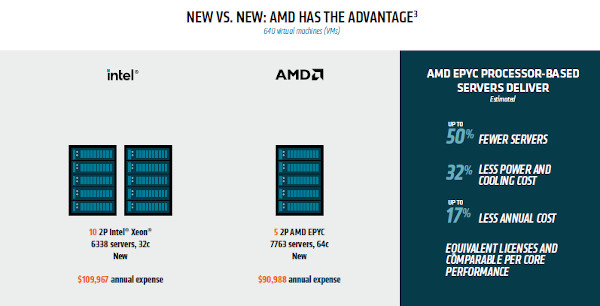
With EPYC x86 server processors capable of seamlessly integrating into existing x86 infrastructures, enterprises can achieve their goals faster and maximize business performance. The latest hardware can also facilitate faster and more agile management methods to promote the business and find customers online, allowing companies to offer customized services and products and better manage inventory and shipments, thanks to innovative features such as virtual prototyping. and purchase advice based on Artificial Intelligence.
Reduced energy consumption
Today there are more and more companies interested in making sustainable choices, from waste reduction and the use of sustainable materials to the transition to renewable energy sources. However, those that continue to rely on outdated hardware risk undermining efforts in other business areas.
Replacing outdated or inefficient technologies can not only reduce carbon dioxide emissions and the amount of heat generated, with positive effects on the cooling of systems in data centers, but can also reduce the costs of running the latter.
AMD EPYC processors are the beating heart of the most energy efficient x86 servers, helping companies to minimize the environmental impact of data centers and achieve sustainability goals. For example, using AMD EPYC 7763-based dual-processor servers to achieve performance in calculating integers per 10,000 points (SPECrate 2017_int_base) can reduce the number of servers by 33%, saving space by 50% and energy by up to 50%. 42%, delivering a three-year total cost of ownership (TCO) reduced by up to 36%, compared to Intel Xeon Platinum 8380-based dual-processor servers.
Safety
Hardware obsolescence not only leads to a potential increase in energy consumption, but also exposes you to a risk of a cyber attack. Five-year-old hardware was not designed to handle the high-risk workloads and security threats we face now – in other words, organizations using outdated servers risk falling victim to hackers and violate data privacy regulations.
In contrast, modern server hardware was designed to deal with the constant proliferation of cybersecurity threats. AMD EPYC processors, for example, feature a fully integrated on-die security processor that helps achieve the level of protection required by business users, as well as several additional features to ensure the security of sensitive data. The security processor helps protect the system during the boot phase and hosts the cryptographic keys.
Innovation
By relying on the latest technologies, companies can make decisions quickly thanks to the availability of huge amounts of data points. To ensure such a competitive advantage, it is important to be sure that you are working efficiently with a modern infrastructure. Relying on obsolete systems carries the risk of being overtaken by the competition that has instead focused on innovation.
Thanks to the high number of cores and the scalability of servers based on third generation AMD EPYC processors, companies can easily equip themselves with applications such as machine learning (ML) and scientific simulations, making the most of the new possibilities offered by Artificial Intelligence ( IA), high-performance computing (HPC) and data analysis.
In an age where data has never been more critical and no compromise on security and performance can be made anymore, AMD EPYC 3rd Generation processors are the ideal choice for businesses looking to upgrade their outdated hardware. It will be easier for companies to reduce Total Cost of Ownership (TCO), not to mention the possibility of maximizing productivity in an ever-changing market. AMD’s online calculation tools can provide support for comparing performance, cost, project energy savings, CO2 emissions, and other parameters of different CPUs as a function of competitiveness. To access these tools, see https://www.amd.com/en/processors/epyc-tools.
.
[ad_2]
Source link
