
[ad_1]
Samsung Electronics announced its new strategy for environmental sustainability: the goal is to achieve zero emissions by 2050. The multinational will focus more on renewables and invest in new technologies, so as to be able to produce more energy efficient products.
Zero CO2 emissions: this is how Samsung aims to reach the goal by 2050
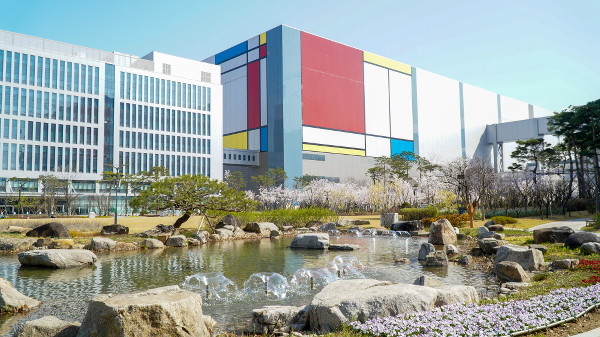
Samsung is working to reduce emissions from its factories and along the supply chain, with the aim of eliminating them by 2050. Some divisions of the giant, such as Device eXperience (which includes Visual Display Business, Digital Appliances Business, Health & Medical Equipment Business, MX Business and Networks Business), will be able to reach net zero as early as 2030, both in terms of direct emissions (Scope 1) and indirect emissions relating to Scope 2, i.e. the impact deriving from the energy used.
Practically, Samsung plans to reduce emissions by the equivalent of approximately 17 million tons of carbon dioxide emissions (CO2e), based on 2021 data.
In this regard, it has joined the global initiative RE100committing to use only energy from renewable sources for all its activities outside of Korea. An objective that, in the case of the Device eXperience division, will be achieved within five years.
In Southwest Asia and Vietnam, the giant’s operations will use only renewable energy from 2022, while for Central and Latin America the target will be reached by 2025. 2027 will be the turn of Southeast Asia, the CIS and Africa.
More and more efficient products
Samsung’s commitment to decarbonisation will also translate into greater attention to the energy efficiency of its products. Starting with the development of ultra-low-power memory chips for data centers and mobile devices, solutions that will see the light by 2025.
Products for the consumer electronics market, such as TVs, smartphones, air conditioners, washing machines and so on, will consume 30% less energy by 2030 compared to devices of equal specifications produced in 2019.
Attention also to the circular economy. Samsung has created the Circular Economy Lab, a laboratory where research will be carried out on materials recycling technologies and processes for extracting resources from waste, with the aim of applying these technologies to maximize the circularity of resources. By 2030, the multinational plans to set up a system that will allow the recycling of minerals extracted from used batteries.

Also for 2030, the company plans to incorporate recycled resin into the plastics used for its products, a percentage that will rise to 100% by 2050. A prime example of this approach has been adopted for the Galaxy Z Fold4made with plastic recycled from discarded fishing nets.
Water is a precious resource
Water use can also be a problem for the environment. According to Samsung’s estimates, the water needs of its operations located in Korea will double by 2030 due to the expansion of semiconductor production capacity. The company promises to optimize them, promoting the reuse of water resources by improving purification plants and to return, by 2030, the same amount of water used through water restoration projects, such as improving water quality and rehabilitation of watercourses.
“The climate crisis is one of the greatest challenges of our time. Failure to act now would lead to unimaginable consequences and for this we must all act, including businesses and governments “, he says. Jong-Hee Han, Vice Chairman and CEO of Samsung Electronicswhich continues, “Samsung is responding to the dangers of climate change with a comprehensive plan that includes reducing emissions, new sustainability practices and developing innovative technologies and better products for our planet.”
“The climate crisis is one of the greatest challenges of our time. Failure to act now would lead to unimaginable consequences and for this we must all act, including businesses and governments“, He declares Jong-Hee Han, Vice Chairman and CEO of Samsung Electronics. “Samsung is responding to the dangers of climate change with an all-encompassing plan that includes reducing emissions, new sustainability practices and developing innovative technologies and better products for our planet“.
.
[ad_2]
Source link
