
[ad_1]
India’s benchmark stock index closed around 18014.60 Monday on positive Wall Street cues late Friday in a late Santa boost. In the first 3-weeks of December, Nifty stumbled almost -5% in line with Dow Future on synchronized global tightening (Fed, ECB, BOE, and also BOJ), more hawkish than expected coupled with a similar RBI hike. Additionally, the Indian market was also undercut by COVID spikes in China, Japan, and South Korea and subsequent pre-cautionary statements by the government along with some fake news/rumor and also India-China LAC skirmish (Arunachal border). In any way, on a day-to-day basis, all major global markets including India primarily follow U.S. cues unless there is any significant local development.
On Friday, Wall Street Futures were almost flat in a light trading session (X-Mas holiday mood) amid mixed economic data. Nowadays, good/better than expected economic data is bad for the market and vice-versa as it may pave the way for higher or lower Fed terminal rates. On Friday, Wall Street was dragged by hotter-than-expected core PCE inflation (annual), better than expected personal income, while boosted by subdued durable goods orders, tepid personal spending, higher UM consumer sentiment, and lower inflation expectations (1Y).
On Thursday Wall Street tumbled after higher than expected revision for Q3CY22 GDP (from prior +2.9% to +3.2% annualized basis); USD surged, and slipped on the perception that Fed may go for at least +50 bps rate hike action in both February and March. Risk trade from America to India was also under stress on COVID spikes in China, Japan, South Korea, and also U.S. This coupled with ultra-hawkish jawboning by both Fed and ECB officials, preparing the market for consecutive 50 bps hikes as the ‘new normal’ created some year-end liquidation panic, causing Wednesday’s Santa rally to stumble.
But late Thursday, Wall Street recovered on short covering after the U.S. Senate passed a huge $1.7T government spending bill that will fund critical government operations across federal agencies and provide emergency aid for Ukraine and natural disaster relief. On Friday, as highly expected U.S. Congress passes the 1-week spending bill. The House approved the one-week extension on Friday ahead of the final vote on the broader spending bill proposed by Republicans. Biden/Democrats will now support it. The market likes such political/policy unity between the ruling (Democrats) and opposition (Republicans) parties in a democracy, which will ensure no big policy paralysis despite a minority government. Overall, the U.S. is providing billions of dollars as a fiscal stimulus in the name of military assistance to Ukraine, which is benefitting the U.S. military-industrial complex.
Now from Wall Street to Dalal Street, India’s Nifty was also boosted by the easing of headline CPI to an 11-month low at +5.88% (y/y), while decreasing -0.11% sequentially (m/m), the 1st decline since Jan’22. But the core CPI increased to +6.036% in November from -5.986% in October (y/y). Overall, the average core inflation for 2022 is now around +6.09%, headline CPI +6.79%, while the WPI inflation is +12.76%.
Sequentially (m/m), the average headline CPI and WPI is now both at around +0.55%, meaning lower/nil pricing power by producers, negative for corporate earnings. Although headline CPI eased and is lowest since Dec’21 due to a seasonal fall in food inflation, core CPI remains sticky around +6.00%, consistently substantially above RBI target +4.00% not only, but at around RBI’s upper tolerance level.
The U.S. economy, labor market, and also inflation is now cooling down without causing an all-out recession; i.e. the economy may be heading for a softish landing. This will ensure less political pressure from the White House on Fed. But Fed may prefer a real positive rate, at least wrt average core inflation (CPI/PCE) of +5.50%. Fed is now jawboning the market for a slower rate of increase, but higher for longer. Fed will now focus on an appropriate terminal rate, restrictive enough (real positive) to bring down inflation towards the +2% target over the medium term.
When the cost of borrowing turns real positive or there is an elevated cost of capital, overall economic activity/demand bounds to slow down, leading to lower inflation (as lower demand will try to catch up with the constrained supply capacity of the economy). Also, a real positive rate would encourage savings than spending, negative for inflation.
Fed is now preparing the market for a possible series of smaller hikes (50 bps) and pauses down the road after reaching around +5.50%. Fed may keep the terminal rate around +5.50% for at least 2023 to bring down core PCE inflation back to +2.00% on a sustainable basis. As the U.S. labor market and inflation are still substantially hot despite some signs of cooling, Fed will continue to hike at +50 bps in February, and then +25 bps in March and May for a terminal rate of +5.50% by May’23.
The market is now expecting Fed will hike +50 bps in February and +25 bps in March for a terminal rate of +5.25% by Mar’23. But Fed may hike to at least +5.50% or even +6.00% to match average core inflation as Powell’s right-hand NY Fed’s Williams indicated Friday. Some days ago, Fed’s Bullard, another influential policymaker indicated a terminal rate between 5-7% (minimum-maximum). Fed/Powell will ensure both financial (Wall Street) and price stability ensuring a softish landing; Fed is prepared to allow the unemployment rate even to 4.5% to bring down core inflation from 6% to 2% in 2023.
Fed is already much behind the inflation curve and thus does not want to be in further lack of credibility issues in 2023; Fed has to bring inflation down to around 2% within 2023 and then in 2024, may go for appropriate rate cuts along with QE-5 to boost up the U.S. economy ahead of Nov’24 Presidential election. The U.S. is now paying around 11% of its revenue as interest on the public debt from around 8% in pre-COVID days. This is almost double that of EU/China and approaching Japan’s 15%. Thus Fed/U.S. policymakers need to bring inflation down to 2% for pre-COVID days borrowing costs; otherwise, it would be an alarming issue for an advanced economy like the U.S.
India’s RBI may also hike +0.25% on 8th February and further +0.25% in April’23 for a terminal rate of +6.75% against the Fed’s +5.50%. India’s core CPI continues to be sticky around +6.00% and thus RBI wants to ensure a real positive rate, wrt at least core inflation.
Thus RBI will continue to tighten to keep interest rate/bond yield differential and also under control, which will also control imported inflation and manage overall price stability. RBI has to tighten in a calibrated way to bring inflation down by curtailing demand; i.e. slowing down the economy to some extent without causing an all-out recession for a safe and soft landing.
As per Taylor’s rule, for India:
Recommended policy rate (I) = A+B+(C+D)*(E-B) =0.50+4+ (1.5+0)*(6-4) =0+4+1.5*2=0.50+4+3=7.50%
Here for RBI/India:
A=desired real interest rate=0.50; B= inflation target =4; C= permissible factor from deviation of inflation target=1.5 (6/4); D= permissible factor from deviation of output target from potential=0; E= average core CPI=6
If Fed continues to hike even after Mar’23 (in case core inflation surges more), then RBI also has to hike (under still elevated/sticky core inflation). Thus RBI may like to keep the repo rate at +6.50/6.75% to +7.50% in FY24, depending upon the Fed rate action; as USD is the reserve/global currency, every major Central Bank has to follow Fed action to maintain bond yield/currency and policy differential (whatever may be the narrative).
As per Taylor’s rule, for the US:
Recommended policy rate (I) = A+B+(C+D)*(E-B) =0.00+2.00+ (0+0)*(5.5-2.00) =0+2+3.5=5.5%
Here for U.S. /Fed
A=desired real interest rate=0.00; B= inflation target =2.00; C= permissible factor from deviation of inflation target=0; D= permissible factor from deviation of output target from potential=0.00; E= average core inflation=5.5% (average of core PCE and CPI)
Looking ahead, whatever may be the narrative, technically Nifty Future now has to sustain over 17900 for a further rally towards 18225/18275-18335/18450-18515/18555 and further 18950/19025 in the coming days; otherwise sustaining below 17850-800, Nifty Future may further fall to 17680/17500-17350/17250 and 17075/16640 in the coming days depending upon Fed/RBI action, Q3FY23 report card, overall macros and FY23 budget/nature of the fiscal stimulus ahead of G20 and early 2024 general election. India is now a major beneficiary of political/policy stability and the appeal of 5D (development, demand, demography, deregulation, and digitalization). 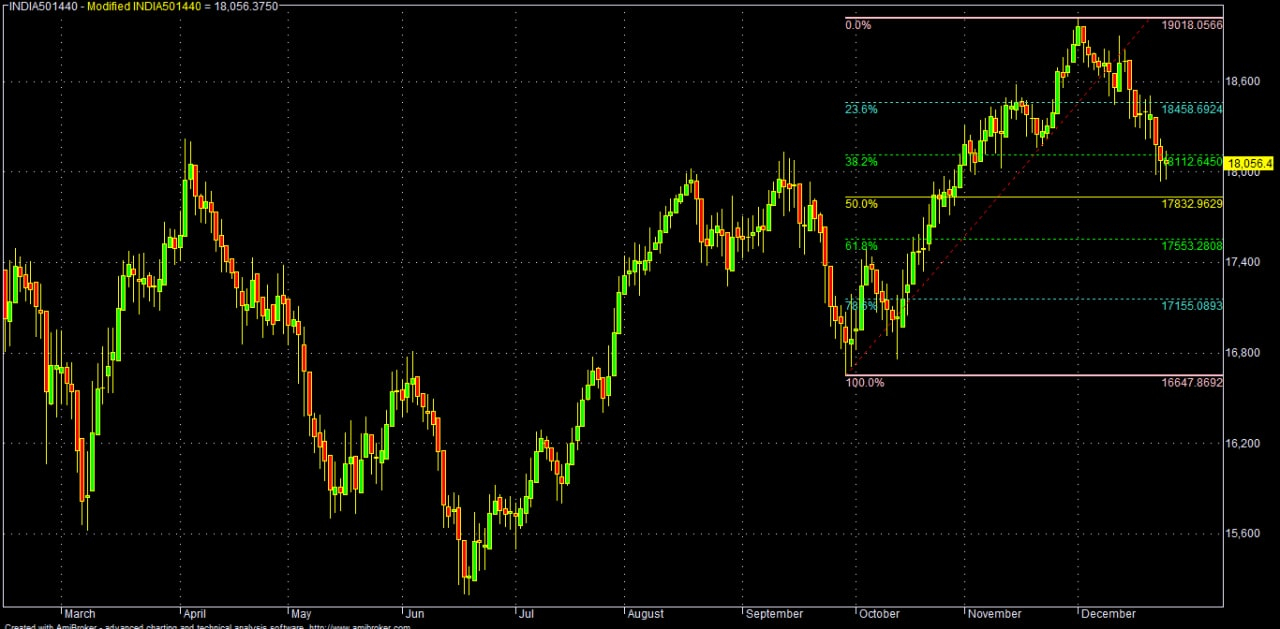
[ad_2]
Source link
(This article is generated through the syndicated feed sources, Financetin doesn’t own any part of this article)
